
In the quest for natural healing and detoxification, few herbs match the power of Bacopa monnieri – known as Brahmi in Ayurveda. This wetland creeper supports brain detox, sharpens memory, calms the mind, and promotes overall vitality – perfect for a plant-based lifestyle.
Botanical and Common Names
- Botanical name: Bacopa monnieri (L.) Wettst. (synonyms: Bacopa monniera, Herpestis monniera, etc.).
- Common names: Brahmi, water hyssop, thyme-leaved gratiola, herb of grace, Indian pennywort. (Note: “Brahmi” is shared with Centella asiatica in some contexts; B. monnieri is the primary nootropic species.)
Family
Plantaginaceae (modern classification; previously Scrophulariaceae).
Origin and Location/Habitat
Native to the wetlands of the Indian subcontinent (India, Sri Lanka, Nepal), Indochina, and Australia; widely naturalised in tropical/subtropical regions including Africa, the Americas, and parts of the southern U.S. It grows in marshy, wet soils, shallow freshwater, or brackish areas up to ~1,500 m elevation, often forming dense mats.
Description
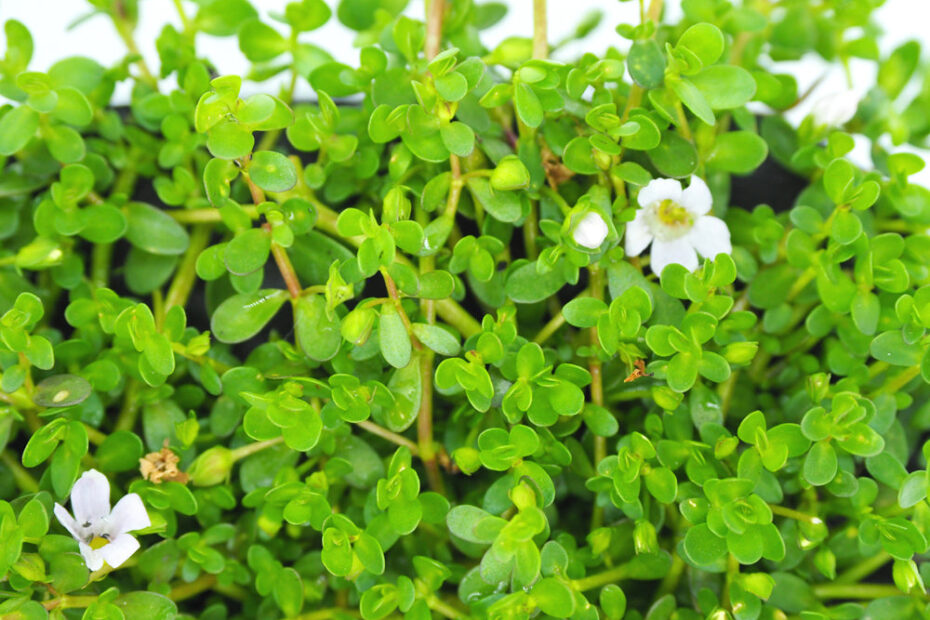
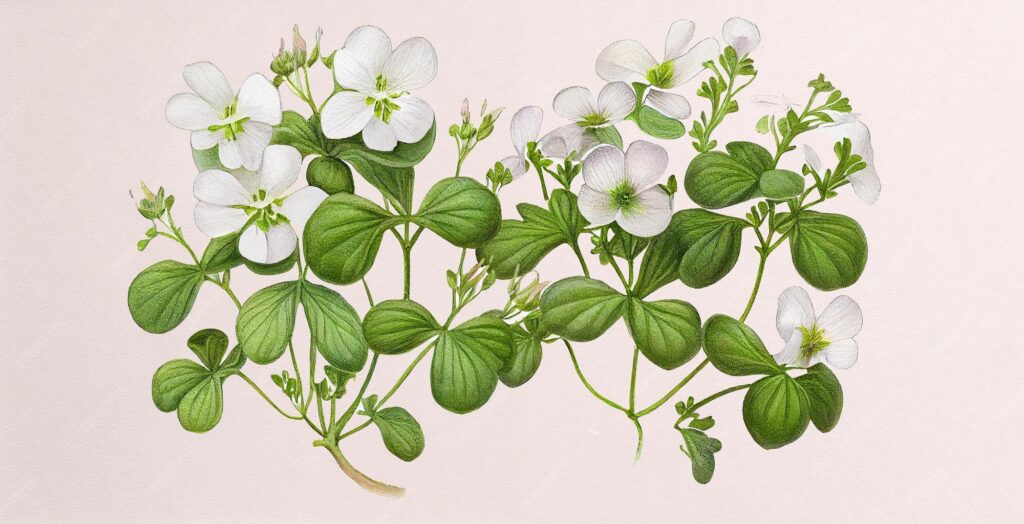
A small, succulent, perennial creeping herb with stems 5-40 cm long that root at nodes. Leaves are opposite, fleshy, oblong to obovate, light green, 4-6 mm thick, with a bitter taste. Flowers are small, solitary, white to pale violet with a yellow center.
Parts Used
Aerial parts (primarily leaves and stems); leaves have the highest concentration of active compounds.
Chemical Constituents / Phytochemistry
Key bioactives are dammarane-type triterpenoid saponins called bacosides (A, B, A3, bacopaside II, etc.), typically standardized to 20-55% in extracts. Other constituents: alkaloids (brahmine, herpestine), flavonoids (apigenin, luteolin), sterols (β-sitosterol), and phenylethanoids.
Actions / Pharmacological Properties
- Primary: Nootropic (enhances memory/learning), neuroprotective, anxiolytic, mild sedative.
- Supporting: Strong antioxidant (increases glutathione, SOD, catalase; reduces lipid peroxidation), anti-inflammatory (inhibits TNF-α, IL-6, NF-κB), anticonvulsant, adaptogenic.
- Mechanisms: Bacosides modulate acetylcholine, enhance synaptic plasticity, protect against oxidative stress/β-amyloid, support GABA, and normalize HPA-axis response.
Classified as a Medhya Rasayana (brain rejuvenator) in Ayurveda.
Traditional Uses
Documented in ancient Ayurvedic texts like the Caraka Samhita (c. 2500–3000 BCE) and Sushruta Samhita for enhancing intellect, memory, concentration; treating anxiety, epilepsy, insomnia, mental fatigue, speech disorders; and promoting longevity/nervous system health. Also used for skin issues, respiratory complaints, inflammation, and as a cardiotonic/diuretic. Preparations: powder with ghee/honey/milk, fresh juice, Brahmi Ghrita (medicated ghee), or oil for scalp massage.
Scientific Research and Evidence
Preclinical: Strong evidence for neuroprotection in models of Alzheimer’s, Parkinson’s, epilepsy, stress, and ischemia via antioxidant, anti-inflammatory, and synaptic mechanisms.
Clinical: Multiple RCTs and systematic reviews show modest improvements in memory (free recall, verbal learning, delayed recall), attention, processing speed, and mild anxiety reduction, especially after 12+ weeks at 300-450 mg standardised extract. Benefits seen in healthy adults, elderly with age-related decline, and some ADHD cases in children. Evidence is promising but mixed for severe dementia/Alzheimer’s; more large trials needed. Generally well-tolerated with high safety profile.
Key supporting studies/reviews:
- Systematic review of RCTs: Improvements in memory free recall and some cognitive domains.
- Meta-analyses and reviews: Consistent modest cognitive benefits, especially memory acquisition and verbal learning.
- Recent trials (2023–2025): Continued support for memory/cognition in healthy and impaired adults, with good tolerability.
- Safety: Non-toxic in studies; mild GI side effects common.
Preparation, Dosage, and Administration
- Standardized extract (20-55% bacosides): 300-450 mg/day (up to 600 mg), divided doses, for ≥12 weeks (effects cumulative).
- Powder: 1-2 g/day (traditionally up to 5-10 g), with honey.
- Tea: 1-2 tsp dried herb steeped 5-10 min; 1-2 cups/day.
- Tincture: 10-20 mL/day.
- Take with food/fat for absorption. Often combined with Ashwagandha or Gotu Kola.
Safety, Side Effects, and Precautions
Well-tolerated short/medium-term; common mild effects: nausea, cramps, increased stools, fatigue. Avoid in pregnancy/breastfeeding (limited data), thyroid issues, bradycardia, or GI/urinary obstruction. Possible mild CYP interactions; consult provider if on medications.
References (selected key sources; many from PubMed/PMC/NIH databases):
- Walker EA, et al. (2023). Bacopa monnieri. StatPearls [NCBI Bookshelf].
- Pase MP, et al. (2012). The cognitive-enhancing effects of Bacopa monnieri: a systematic review of randomized, controlled human clinical trials. J Altern Complement Med.
- Brimson JM, et al. (2021). The effectiveness of Bacopa monnieri as a nootropic, neuroprotective, or antidepressant supplement. Sci Rep.
- Neto LJV, et al. (2024). Investigating the neuroprotective and cognitive-enhancing effects of Bacopa monnieri: A systematic review focused on inflammation, oxidative stress… Antioxidants.
- Gościniak A, et al. (2025). Bacopa monnieri: Preclinical and Clinical Evidence of Neuroactive Effects… Nutrients.
- Calabrese C, et al. (2008). Effects of a standardized Bacopa monnieri extract… J Altern Complement Med (classic high-citation trial).
- Kumar N, et al. (2016). Efficacy of standardized extract of Bacopa monnieri… Evid Based Complement Alternat Med.
- Traditional Ayurvedic context: Caraka Samhita references (e.g., as Medhya Rasayana for mental disorders).
This article is copyrighted by Ital is Vital, 2016 - 2026. Want to re-post this article? Visit our guidelines.
DISCLAIMER: THIS WEBSITE DOES NOT PROVIDE MEDICAL ADVICE
The information, including but not limited to, text, graphics, images and other material contained on this website are for informational purposes only. The purpose of this website is to promote broad consumer understanding and knowledge of various health topics. It is not intended to be a substitute for professional medical advice, diagnosis or treatment. Always seek the advice of your physician or other qualified health care provider with any questions you may have regarding a medical condition or treatment and before undertaking a new health care regimen, and never disregard professional medical advice or delay in seeking it because of something you have read on this website.