
Botanical Name
Gomphrena celosioides Mart.
Common & Vernacular Names
- Prostrate globe amaranth
- Soft khaki weed
- Wild gomphrena
- Often misidentified as Gomphrena serrata
Botanical Family
Amaranthaceae
Botanical Classification
- Kingdom: Plantae
- Order: Caryophyllales
- Family: Amaranthaceae
- Genus: Gomphrena
- Species: G. celosioides
Botanical Description
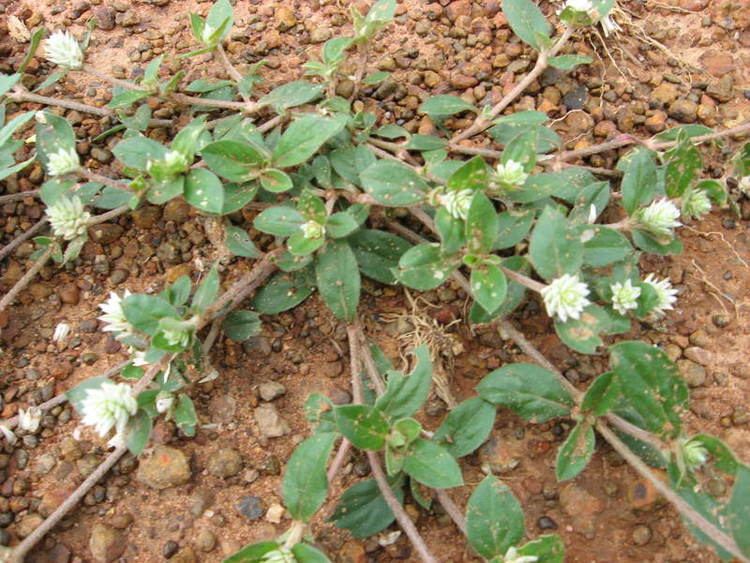
Gomphrena celosioides is a low-growing, spreading perennial herb commonly found in tropical and subtropical regions. The plant forms a prostrate mat close to the ground and thrives in disturbed soils.
- Leaves: Opposite, oval to lance-shaped, slightly rough or softly hairy, medium green
- Stems: Slender, branching, not aggressively rooting at nodes
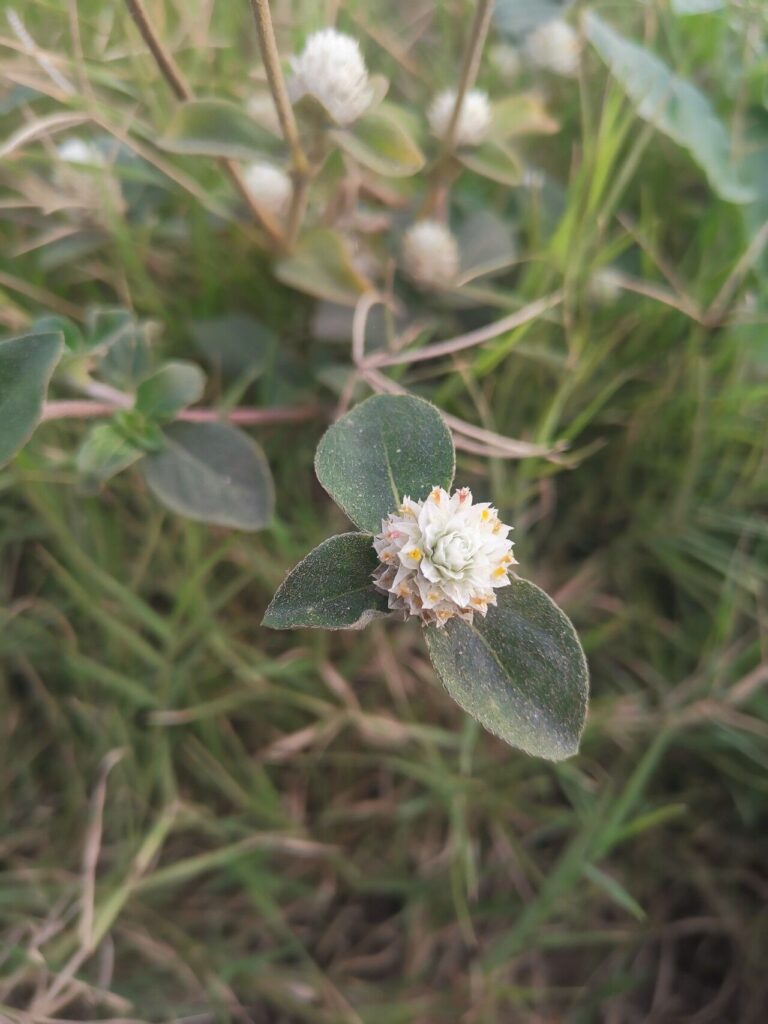
- Flowers: Distinct rounded or slightly oval flower heads; typically white, cream, or pale pink; borne on short stalks
- Roots: Fibrous
The spherical flower heads are the most reliable identifying feature and clearly distinguish this species from creeping Alternanthera species.
Habitat & Distribution
Gomphrena celosioides has a broad pantropical distribution and is found across:
- West, Central, and Southern Africa
- The Caribbean
- Central and South America
- Parts of Southeast Asia and the Pacific
The plant thrives in warm climates and commonly appears in disturbed or compacted soils, including roadsides, lawns, agricultural margins, fallow land, and open fields. It flourishes during rainy seasons and demonstrates strong resilience in nutrient-poor environments, contributing to its widespread naturalisation beyond its original range.
Parts Used
- Leaves
- Stems (aerial parts)
- Whole plant (traditional use)
Traditional & Ethnomedicinal Uses
Across multiple traditional healing systems, Gomphrena celosioides has been valued as a cooling, cleansing, and inflammation-modulating herb. Its use spans Africa, the Caribbean, and parts of the Americas, where it is generally regarded as a gentle yet supportive plant suitable for foundational or restorative protocols.
African Traditional Use
In various African herbal traditions, Gomphrena celosioides has been used to:
- Reduce internal heat and fever
- Ease inflammatory conditions
- Support respiratory comfort during coughs or chest congestion
- Assist gentle blood and lymphatic cleansing
Preparations are typically simple teas or decoctions made from the aerial parts, reflecting its role as a supportive, everyday medicinal rather than an emergency remedy.

Caribbean Folk Medicine
In Caribbean herbal practice, Gomphrena species are commonly used as cooling bush teas. Traditional uses include:
- Fever management and cooling the body
- Supporting digestion and bowel regularity
- Mild cleansing after illness
- General wellness tonics, especially during seasonal changes
The plant is often combined with other mild herbs rather than used alone.
Latin American & South American Traditions
In parts of Central and South America, where the plant is widespread, Gomphrena celosioides is used in folk medicine for:
- Inflammation and pain relief
- Respiratory complaints
- Detoxification and internal cleansing
- Support during convalescence
Some traditions also apply the plant topically as washes or poultices for minor wounds, swelling, and skin irritation.
Overall Cultural Pattern of Use
Across cultures, a consistent theme emerges: Gomphrena celosioides is viewed as a balancing and restorative herb, not a forceful or drastic intervention. Its value lies in gradual support, cooling excess heat, and assisting the body’s natural regulatory processes rather than aggressive purging.
This shared pattern across regions reinforces its role as a foundational medicinal plant rather than a highly targeted or acute remedy.
Herbal Actions
- Anti-inflammatory
- Cooling
- Mild diuretic
- Detox-supportive
- Mild antimicrobial
- Lymphatic supportive
Rather than acting forcefully, Gomphrena celosioides supports the body’s natural elimination and regulatory pathways.
Phytochemical & Nutritional Overview
While Gomphrena celosioides has not been as extensively studied as some major medicinal herbs, available analyses and ethnobotanical literature indicate the presence of:
- Flavonoids
- Phenolic compounds
- Saponins
- Triterpenoids
- Plant sterols
These constituents are commonly associated with anti-inflammatory, antioxidant, and tissue-protective activity. The combination of flavonoids and phenolic compounds likely underpins the plant’s traditional use for cooling, inflammation modulation, and gentle cleansing.
As with many widely used folk herbs, its efficacy appears to arise from synergistic whole-plant activity rather than from a single isolated compound.
Modern Research Notes (Cautious Overview)
Modern scientific research on Gomphrena celosioides remains limited but supportive of its traditional applications.
Preliminary studies on Gomphrena species suggest:
- Anti-inflammatory potential
- Antioxidant activity
- Mild antimicrobial effects
These findings align with long-standing folk uses for inflammation, fever, and skin-related conditions. However, current evidence is preclinical and should be interpreted as supportive rather than definitive. The plant remains best understood through traditional use rather than clinical application.
Safety, Contraindications & Precautions
- Traditionally regarded as safe when used in moderate, traditional preparations
- Due to its mild diuretic action, excessive use may contribute to increased fluid loss
- Individuals with chronic illness, those taking pharmaceutical diuretics, or those under medical supervision should exercise caution
- Pregnant or breastfeeding individuals should consult a qualified healthcare or herbal professional before use
No severe toxicity has been reported in traditional contexts, though concentrated extracts are not historically documented.
Taxonomy, Identification & Misidentification Notes
Correct identification is essential due to frequent confusion with related species.
- Gomphrena celosioides is often mislabeled as Gomphrena serrata in online sources and informal herbal markets
- True G. serrata is more commonly documented in parts of Asia and the Americas
- Confusion also occurs with Alternanthera species (sometimes called “arrasa con todo”), which differ botanically and medicinally
Key distinguishing features of Gomphrena celosioides include:
- Rounded, button-like flower heads
- Opposite leaves with a slightly rough or softly hairy texture
- Non-creeping stems that do not root aggressively at nodes
Clear identification helps prevent inappropriate substitution and overestimation of medicinal strength.
Preparation Methods (Traditional)
Traditional preparations of Gomphrena celosioides are intentionally simple, reflecting the plant’s gentle nature.
- Infusion / Tea: Fresh or dried aerial parts steeped in hot water
- Decoction: Whole plant gently simmered for more sustained extraction
- Topical Wash: Cooled tea used externally for skin applications
These preparations are typically mild and are often taken over time rather than as a single, strong dose.
Traditional Recipes & Herbal Combinations
The following preparations reflect documented traditional practice rather than modern clinical prescriptions. Quantities are intentionally conservative and may vary by region and practitioner.
1. Single-Herb Cooling Tea
Traditional use: Fever, internal heat, general cleansing
- Fresh or dried Gomphrena celosioides aerial parts
- Hot water
The plant is infused or lightly decocted and consumed as a mild tea, often once daily during periods of heat or discomfort.
2. Cooling & Cleansing Herbal Blend
Traditional use: Inflammation, seasonal cleansing, post-illness support
Commonly combined with other gentle, cooling herbs such as:
- Hibiscus (Hibiscus sabdariffa)
- Lemongrass (Cymbopogon citratus)
- Guinea hen weed / Anamu (Petiveria alliacea) — used sparingly
This blend is prepared as a light decoction and taken short-term as part of a broader cleansing or restorative protocol.
3. Respiratory Support Tea (Folk Use)
Traditional use: Mild coughs, chest discomfort
Often combined with:
- Ginger (Zingiber officinale) in small amounts
- Licorice root (Glycyrrhiza glabra) where culturally available
These combinations reflect regional adaptations and are typically used for short durations.
4. Topical Wash or Compress
Traditional use: Skin irritation, swelling, minor wounds
A stronger decoction of Gomphrena celosioides is allowed to cool and applied externally as a wash or compress.
Notes on Traditional Use
Across cultures, Gomphrena celosioides is rarely used in isolation for aggressive intervention. Instead, it is valued as a supportive base herb, often paired with complementary plants to enhance cooling, cleansing, or soothing effects.
Taste & Energetics
- Taste: Mild, slightly bitter, neutral
- Energetics: Cooling, moistening
These qualities make it particularly suitable for conditions associated with heat, irritation, or stagnation.
Relationship to Similar Species
Gomphrena celosioides vs. Gomphrena serrata
- G. celosioides is far more common in West Africa
- G. serrata is more frequently documented in Asia and the Americas
- Many online sources misapply the name G. serrata to G. celosioides
Gomphrena vs. “Arrasa con Todo” (Alternanthera spp.)
Although both belong to the Amaranthaceae family, Gomphrena species differ significantly from Alternanthera:
- Gomphrena has rounded, button-like flower heads
- Alternanthera produces small white papery clusters at leaf axils
- Alternanthera roots aggressively at nodes; Gomphrena does not
Medicinally, Alternanthera species are generally considered more aggressive, while Gomphrena species are gentler and more balancing.
Dr. Sebi-Inspired Perspective
From a Dr. Sebi-inspired, African biomineral balance framework, Gomphrena celosioides is valued as:
- A naturally occurring, non-hybrid wild plant
- A gentle cleanser that supports circulation and elimination pathways
- A cooling herb that aligns with alkaline-focused dietary and lifestyle principles
Within this perspective, the plant’s value lies in its compatibility with the body’s regulatory systems, emphasizing consistency and balance rather than intensity.
Safety & Precautions
- Traditionally regarded as safe when used appropriately
- Avoid excessive or concentrated use without proper guidance
- Pregnant or breastfeeding individuals should consult a qualified practitioner before use
References & Further Reading
The following references reflect ethnobotanical, herbal, and regional plant-use literature where Gomphrena celosioides and related species are documented:
- Burkill, H. M. The Useful Plants of West Tropical Africa. Royal Botanic Gardens, Kew.
- Duke, J. A. Handbook of Medicinal Herbs. CRC Press.
- Morton, J. F. Atlas of Medicinal Plants of Middle America. Charles C. Thomas.
- Quattrocchi, U. CRC World Dictionary of Medicinal and Poisonous Plants. CRC Press.
- Regional ethnobotanical surveys from Africa, the Caribbean, and South America documenting traditional Gomphrena use.
Summary
Gomphrena celosioides is a widely distributed yet often overlooked medicinal herb found throughout tropical regions of the world. Recognizable by its rounded flower heads and low-growing habit, it has a long history of use across multiple cultures as a cooling, anti-inflammatory, and cleansing plant. While frequently misidentified as Gomphrena serrata or confused with Alternanthera species, its gentle nature and consistent traditional applications make it a valuable component of foundational herbal knowledge.
This monograph is intended for educational and traditional knowledge purposes.
This article is copyrighted by Ital is Vital, 2016 - 2026. Want to re-post this article? Visit our guidelines.
DISCLAIMER: THIS WEBSITE DOES NOT PROVIDE MEDICAL ADVICE
The information, including but not limited to, text, graphics, images and other material contained on this website are for informational purposes only. The purpose of this website is to promote broad consumer understanding and knowledge of various health topics. It is not intended to be a substitute for professional medical advice, diagnosis or treatment. Always seek the advice of your physician or other qualified health care provider with any questions you may have regarding a medical condition or treatment and before undertaking a new health care regimen, and never disregard professional medical advice or delay in seeking it because of something you have read on this website.