
Petty Spurge (Cancer Weed): History, Traditional Uses, Actions, Risks & Modern Insight
Botanical Name: Euphorbia peplus L.
Family: Euphorbiaceae
Common Names: Petty spurge, Cancer weed, Radium weed, Milkweed
Habitat: Hedgerows, gardens, pavements, disturbed soils (common throughout the UK and Europe)
Petty spurge (Euphorbia peplus) is a small, unassuming plant frequently dismissed as a nuisance weed. Yet for centuries, it has occupied a significant place in European folk medicine, classical herbalism, and early medical traditions, particularly in relation to stubborn skin conditions. Commonly encountered along UK hedgerows and garden edges, this plant has long been recognised for its powerful milky latex sap – a substance both feared and respected.
Unlike many gentle medicinal herbs, petty spurge has always been approached as a plant of precision, used sparingly and with full awareness of its potential dangers.
Botanical Description & Identification
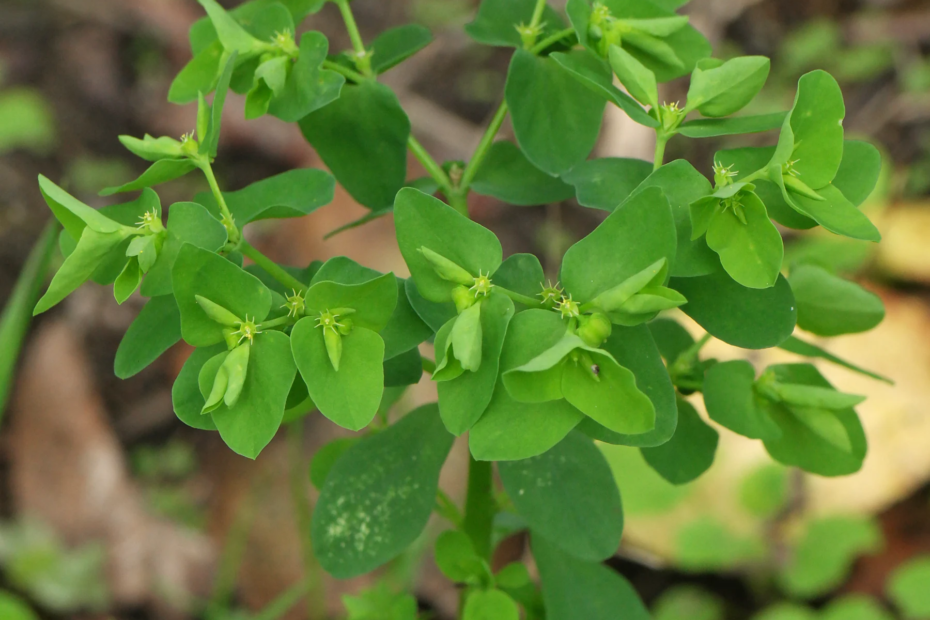
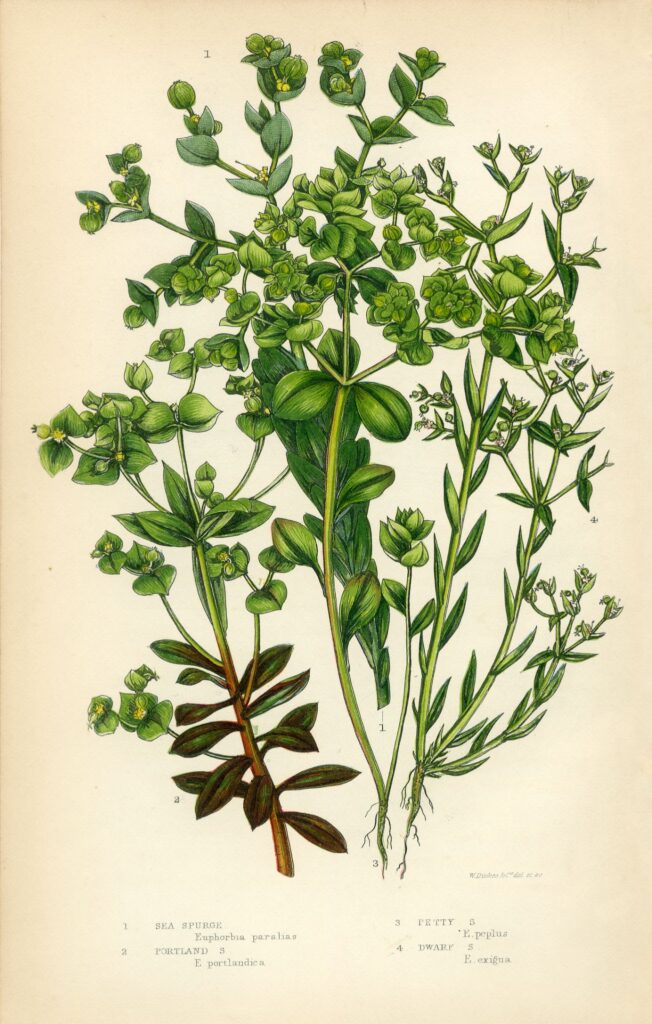
Petty spurge is a small annual herb, typically growing between 5-30 cm tall. It has smooth, hairless green stems and oval to oblong bright green leaves with smooth margins. The flowers are small and greenish-yellow, clustered at the stem tips.
When the stem or leaves are broken, the plant exudes a thick white latex sap, which is the defining characteristic of the species and the source of its medicinal reputation as well as its toxicity.
Habitat & Distribution
Native to Europe, North Africa, and Western Asia, Euphorbia peplus is now widespread throughout the UK. It thrives in:
- Hedgerows
- Garden borders
- Pavements and cracks
- Waste ground and cultivated soil
It prefers light, well-drained soils and self-seeds readily, often appearing in spring and early summer.
Historical & Traditional Uses
Classical Antiquity
The medicinal use of spurges dates back to ancient Greek and Roman medicine. Writers such as Dioscorides and Pliny the Elder documented various Euphorbia species as strong medicinal agents. Within humoral medicine, spurges were classified as hot and dry, used to expel excess or corrupted humours from the body.
Petty spurge, being milder than some larger species, was favoured for external use, particularly where tissue destruction was required.
Medieval European Herbalism
During the Middle Ages, petty spurge became firmly embedded in European folk medicine. It appears in Anglo-Saxon herbals, monastic manuscripts, and medieval leechbooks, primarily as a topical remedy.
The fresh sap was traditionally applied to:
- Warts
- Corns
- Calluses
- Hardened nodules and swellings
These growths were believed to arise from impure blood or lymph. The caustic sap was thought to “consume” or “eat away” diseased tissue. Medieval practitioners repeatedly warned that the sap must be applied only to the affected area, avoiding healthy skin.
“Cancer Weed” and Pre-Modern Cancer Concepts
The name “cancer weed” reflects historical medical language rather than modern oncology. In earlier centuries, “cancer” referred broadly to hard, spreading, ulcerated, or non-healing growths, especially those that appeared to erode surrounding tissue.
Petty spurge was traditionally applied to:
- Persistent skin ulcers
- Hard, waxy growths
- Lesions resistant to healing
Importantly, historical sources describe external use only. The plant was never regarded as a systemic cure but as a localized intervention for surface conditions.
Renaissance & Early Modern Herbalists
By the 16th and 17th centuries, herbalists such as Nicholas Culpeper documented petty spurge while emphasising caution. It was described as a plant that removed “superfluous flesh” and cleansed “ill-conditioned sores.”
The doctrine of signatures sometimes influenced interpretation: the burning, corrosive nature of the sap symbolised its capacity to break down hardened pathological tissue.
Folk Medicine into the 19th Century
In rural Britain and Ireland, petty spurge remained a common wart remedy well into the 1800s. Application was typically done using a straw, feather, or small stick rather than fingers.
Across Southern Europe and parts of North Africa, spurges were also used externally to cauterise wounds and growths. Internal use persisted in some regions but was increasingly recognised as dangerous.
Internal Use: Historical but Obsolete
Historically, petty spurge and related species were sometimes administered internally as:
- Violent purgatives
- Treatments for dropsy (fluid retention)
- Remedies for blocked humours
These practices carried serious risk. By the 18th and 19th centuries, physicians increasingly warned against internal use due to severe gastrointestinal distress and toxicity. Modern herbalism does not support internal use of Euphorbia peplus.
Phytochemistry & Active Compounds
The biological activity of petty spurge is largely attributed to diterpene esters, particularly:
- Ingenol mebutate
- Jatrophane diterpenes
- Pepluane diterpenes
Additional constituents include flavonoids, sterols, tannins, and triterpenes. Ingenol mebutate later became the basis for a prescription pharmaceutical treatment for actinic keratosis, confirming that historical observations were grounded in real biochemical activity.
Traditional Herbal Actions
From a traditional perspective, petty spurge is described as:
- Caustic
- Vesicant (blister-forming)
- Cytotoxic
- Tissue-destructive (topical only)
These actions explain its long-standing use against unwanted or abnormal skin growths.
Modern Medical Interest
Modern research into Euphorbia peplus led to the isolation of ingenol compounds, validating certain traditional uses under controlled medical conditions. Topical preparations derived from the plant have demonstrated effectiveness against precancerous skin lesions, though such treatments require professional oversight.
Safety, Toxicity & Contraindications
Petty spurge is not a safe general-use herb.
- The sap can cause severe skin irritation, blistering, and burns
- Eye contact may lead to intense inflammation and potential injury
- Sap and seeds are poisonous if ingested
Handling precautions include wearing gloves, avoiding contact with eyes and face, and keeping the plant away from children and animals.
Ecological Notes
Petty spurge is a resilient annual that thrives in disturbed environments. Though often labelled a weed, it plays a role in local ecosystems and demonstrates the complex chemistry that many overlooked plants possess.
Conclusion
Petty spurge (Euphorbia peplus) stands as a powerful example of how traditional herbal knowledge, when carefully examined, can intersect with modern science. Historically valued for its ability to address stubborn skin conditions, it has always been recognised as a plant requiring restraint and respect.
This is not a beginner’s herb, nor one suited to casual experimentation, but rather a reminder that herbal medicine has always balanced efficacy with responsibility.
References
- Dioscorides. De Materia Medica
- Pliny the Elder. Natural History
- Culpeper, N. The Complete Herbal
- Grieve, M. A Modern Herbal
- British Journal of Dermatology – studies on Euphorbia peplus and ingenol mebutate
- Mecklenburgh Square Garden. Common Garden Spurge (Euphorbia peplus)
- Laura Hatch. Petty Spurge Plant Profile and Toxicity
- Queensland Poisons Information Centre. Petty Spurge Toxicity Overview
- Mecklenburgh Square Garden. Common Garden Spurge (Euphorbia peplus).
- Laura Hatch. Petty Spurge (Euphorbia peplus) – Plant Profile & Toxicity.
- Ramsay, J. R. et al. Topical Treatment of Non-Melanoma Skin Cancer with Euphorbia peplus Sap. British Journal of Dermatology.
- Wikipedia. Euphorbia peplus.
- Queensland Poisons Information Centre. Petty Spurge Toxicity Overview.
- Jardinería On. Euphorbia peplus: Characteristics and Uses.
This article is copyrighted by Ital is Vital, 2016 - 2026. Want to re-post this article? Visit our guidelines.
DISCLAIMER: THIS WEBSITE DOES NOT PROVIDE MEDICAL ADVICE
The information, including but not limited to, text, graphics, images and other material contained on this website are for informational purposes only. The purpose of this website is to promote broad consumer understanding and knowledge of various health topics. It is not intended to be a substitute for professional medical advice, diagnosis or treatment. Always seek the advice of your physician or other qualified health care provider with any questions you may have regarding a medical condition or treatment and before undertaking a new health care regimen, and never disregard professional medical advice or delay in seeking it because of something you have read on this website.